
OKRs can’t save your business
But the right goal-setting and prioritization frameworks might. Here’s how to pick the one that actually fits your company or team.

From mindset to mechanics
Welcome to week two of the “learn from my mistakes” series on annual planning. Last week was all about mindset; this week is about frameworks – picking the right goal-setting structure for your company’s current chapter. If you did the homework, it’s about to pay off.
Story time: the two-week OKRs
I once rolled out OKRs that lasted exactly two weeks.
Yep, you read that right. 😬
Two and a half months of leadership time spent in brainstorming sessions, workshops, and feedback loops... gone in an instant.
It was an expensive, egg-on-my-face moment, but also a turning point for me as an operator.
I’d just joined as Chief of Staff with a clear mandate: bring structure, drive alignment, and professionalize ways of working. I was literally hired to introduce OKRs, and I wanted to make an impact fast. I was determined to make them clean, strategic, and measurable. Everything we should have been doing.
I did what any well-intentioned overachiever would do. I built templates, ran workshops, and pulled every leader into the process. I framed it as a new era of alignment. It felt good. We were being disciplined.
But I wasn’t paying close enough attention to what was happening outside the room. The markets were shifting. The story had changed from growth to survival, and I didn’t see it soon enough.
Two weeks after launch, the OKRs were buried.
No dramatic announcement. Just a quiet fade as everyone realized we had bigger fires to put out. Honestly? It made sense. We didn’t need structure. We needed focus.
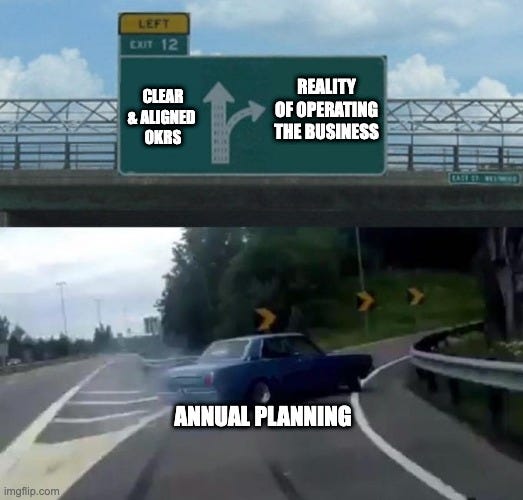
That experience taught me something I’ve carried into every planning season since: structure only works if it fits the moment.
Frameworks and why they matter
Among other reasons, frameworks exist to:
Organize and create alignment across teams
Give people guardrails to operate within
Rally everyone around a shared direction
But they only work if they fit the company’s current reality. Pick the wrong one, and you’ll either over-engineer or under-steer your planning process.
If you need a refresher, here are the most common frameworks:
OKRs (Objectives & Key Results): If you’re here, you know what these are already 🙂
MBOs/SMART Goals: Top-down, quantifiable targets linked to performance
Rocks/Pebbles/Sand: Prioritization model for tackling big goals first, then supporting work
Strategic Themes/North Stars: Broad directional focus or rallying cry
V2MOMs: Vision, Values, Methods, Obstacles, Measures - a narrative framework connecting vision to execution. Not convinced any company besides Salesforce has actually used these well, though…
Which framework is right for your team?
Asking “Should we use OKRs?” is a good start, but the better question is “How much structure can our company handle right now?”. When in doubt, less is more. Use this chart as a quick gut check:
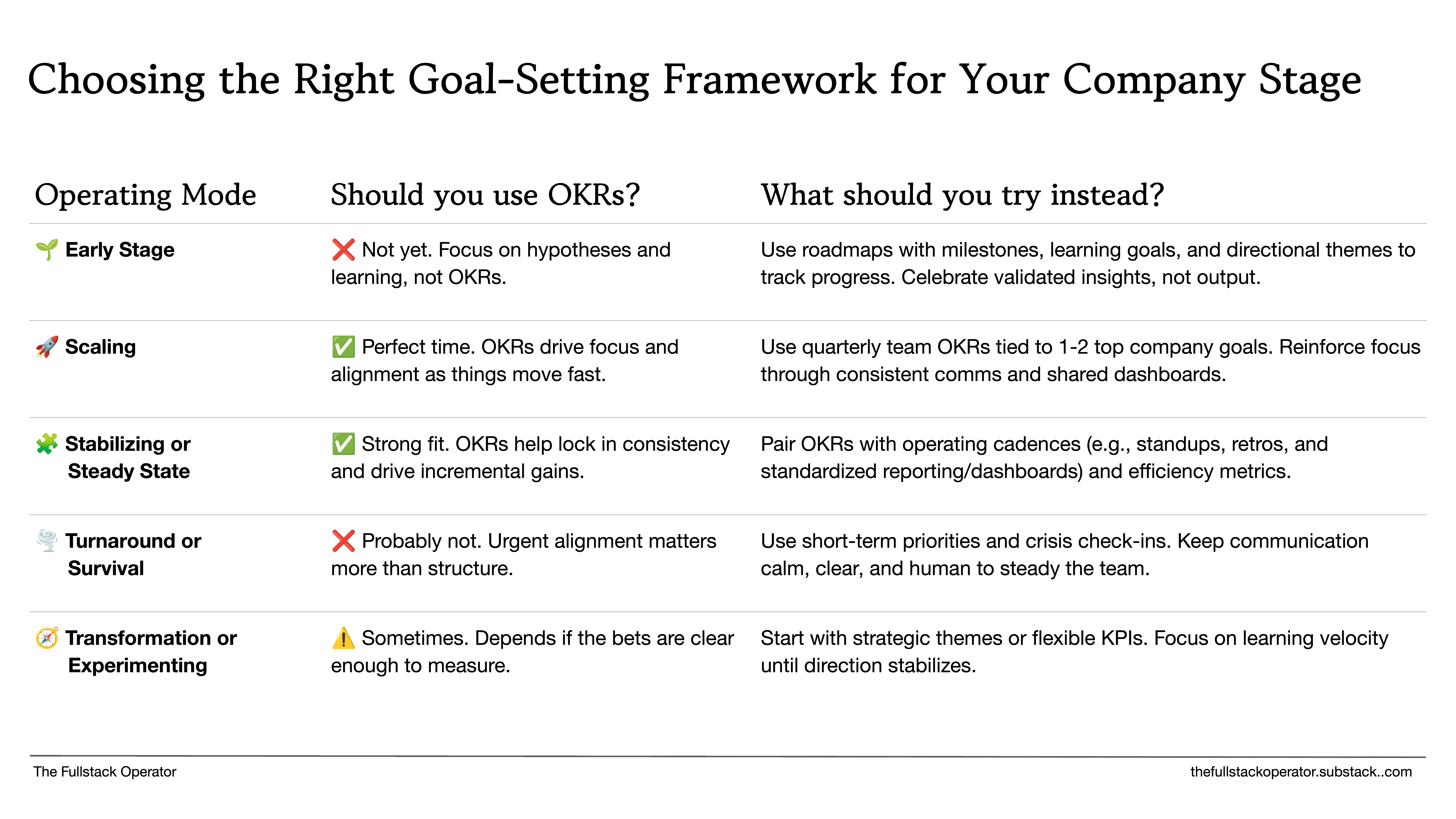
When growth is stable and your strategy is clear, frameworks like OKRs and MBOs can help you focus and measure progress.
But when you’re in flux (ex: launching new products, finding product-market fit, or turning around business performance), you need flexibility, not rigor. Think themes, milestones, or weekly crisis check-ins.
The bottom line: meet the company where it is, not where you wish it were.
Validate it with what’s true
If you did last week’s homework, this is where it comes into play. Before you lock in a framework, check whether your org is ready for that level of structure.
Remember, team size doesn’t equal maturity. A 200-person company can operate like a 20-person startup, and vice versa. And what works now might not work next quarter.
Here’s a quick reference guide:
▶️ OKRs
Financials: Predictable revenue and steady growth; missing a stretch goal won’t tank the business
People/Team: Experienced leaders and strong cross-functional trust
Market: Stable dynamics and clear data signals
Non-negotiables: Manageable number of fixed projects; capacity for new bets
▶️ MBOs/SMART Goals
Financials: Stable, target-driven environment
People/Team: Senior, performance-oriented groups
Market: Defined success metrics in a mature space
Non-negotiables: Predictable planning horizon; low volatility
▶️ Rocks/Pebbles/Sand
Financials: Breakeven or constrained resources; every dollar has to count
People/Team: Emerging leadership; improving coordination
Market: Still shifting; need focus over forecasts
Non-negotiables: Competing priorities across functions
▶️ Strategic Themes/North Stars
Financials: Uncertain or inconsistent results; budget is more of a suggestion than a system
People/Team: Lightweight or early-stage structure
Market: Fluid and exploratory
Non-negotiables: Many external dependencies
▶️ V2MOMs
Financials: Direction mostly clear, but flexibility needed
People/Team: Managers building structure and planning muscle
Market: Some volatility; strategy still evolving
Non-negotiables: A few fixed initiatives and room to adjust
To wrap this up
Don’t get me wrong. I love OKRs! They’ve helped me align cross-functional teams and make amazing things happen.
But there’s a time and a place for them. They’re not a silver bullet. Sometimes the bravest, smartest move you can make is to pick less structure, not more.
Next week, we’ll dig into the hardest part of planning season: getting people to yes. Because any framework is only as strong as the alignment behind it.
Rooting for you,
- Keely